


A Kilometer from Everywhere


Nine days, one island, and Imagine5’s fifth issue
There is a particular kind of anticipation that comes with waiting for something you already know you will love.
I had pre-ordered Imagine5’s fifth issue the moment it became available. For weeks afterwards, I checked the mailbox with an odd mixture of impatience and restraint - the way you do when you want something badly enough to be slightly afraid of finally having it.
When it arrived, I put it aside.
Not because I wasn't excited. Almost the opposite. I didn't want to tear into it between emails, errands and the thousand small interruptions that usually make up a day. I wanted to give it the kind of attention the magazine itself seems to ask for. So I waited. Until we went to Lupa Island.
Lupa is a small island in the Danube, just north of Budapest. From the city, it is barely a kilometer away as the crow flies, yet arriving there feels like crossing a much greater distance. There are just around a hundred cabins, an old-fashioned bistro stuck in time and space and little else. You come by on a boat, or by a tiny passenger ferry that runs when it runs. The signal comes and goes. There is no real internet. The mainland remains visible, but somehow becomes irrelevant.
For nine days, we stayed there. Just us, the swimming suits, some books and analogue cameras. And for nine days, life became very small.
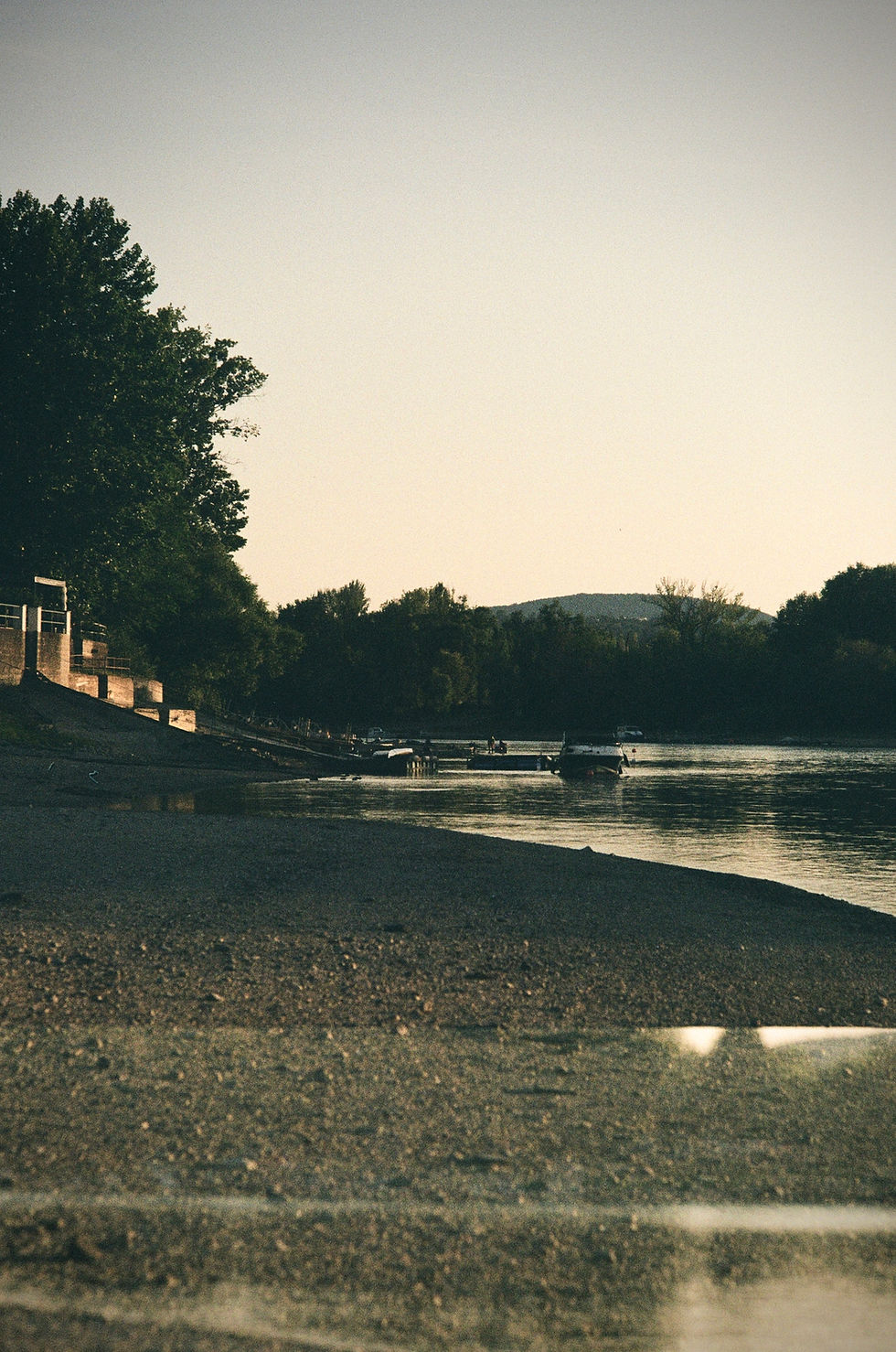
Birdsong in the morning, occasionally interrupted by the distant hum of the highway across the river. Swimming when the heat became too much. Long, unhurried afternoons. Crickets taking over as the sun disappeared, followed by owls once the island went properly dark. That summer, the Danube was at a record low, and for once its water was astonishingly clear - low enough that the usual traffic of motorboats and jet-skis could no longer stir up the familiar veil of silt.
There was nothing particularly remarkable to do. That was the remarkable part.
It was somewhere in that slowness that I realised I had never actually spent this much uninterrupted time on Lupa. In fact, I had never even stayed a full night. For years, whenever I needed to feel renewed, my instinct had been to go somewhere else. Another country. Another landscape. Another cuisine. Other people's ways of living.
And all along, a kilometer from my front door, there had been this little world: a community established in the 1930s, where houses carry decades of memory, where some have remained in the same families for generations, where people still know one another. It was a useful reminder that distance and discovery are not the same thing.
Sometimes you don't have to go further. You just have to stay long enough to notice. That was the state of mind in which I finally opened Imagine5. And perhaps that is why this Volume 5 stayed with me so strongly.

Its official theme is rewilding. But like the best ideas, it refuses to stay inside its own definition. The word slowly expands as the magazine moves through landscapes, food, farming, traditions, sport, culture and coexistence - and, somewhere along the way, begins to suggest something less literal: a rewilding of our attention, our habits, even our capacity for wonder.
This is what Imagine5 does exceptionally well.
It never seems particularly interested in telling us what we should think. Instead, it makes us curious enough to want to look again.
That distinction matters.
The 5 Team seems to have understood something that much environmental communication is still struggling with: sustainable change does not begin with information. It begins when an idea becomes part of culture - when it enters the stories we tell, the things we notice, the food we make, the people we admire, the images we remember.
And culture moves differently. It needs beauty. It needs humour. It needs contradiction. It needs time.
This magazine understands this instinctively.
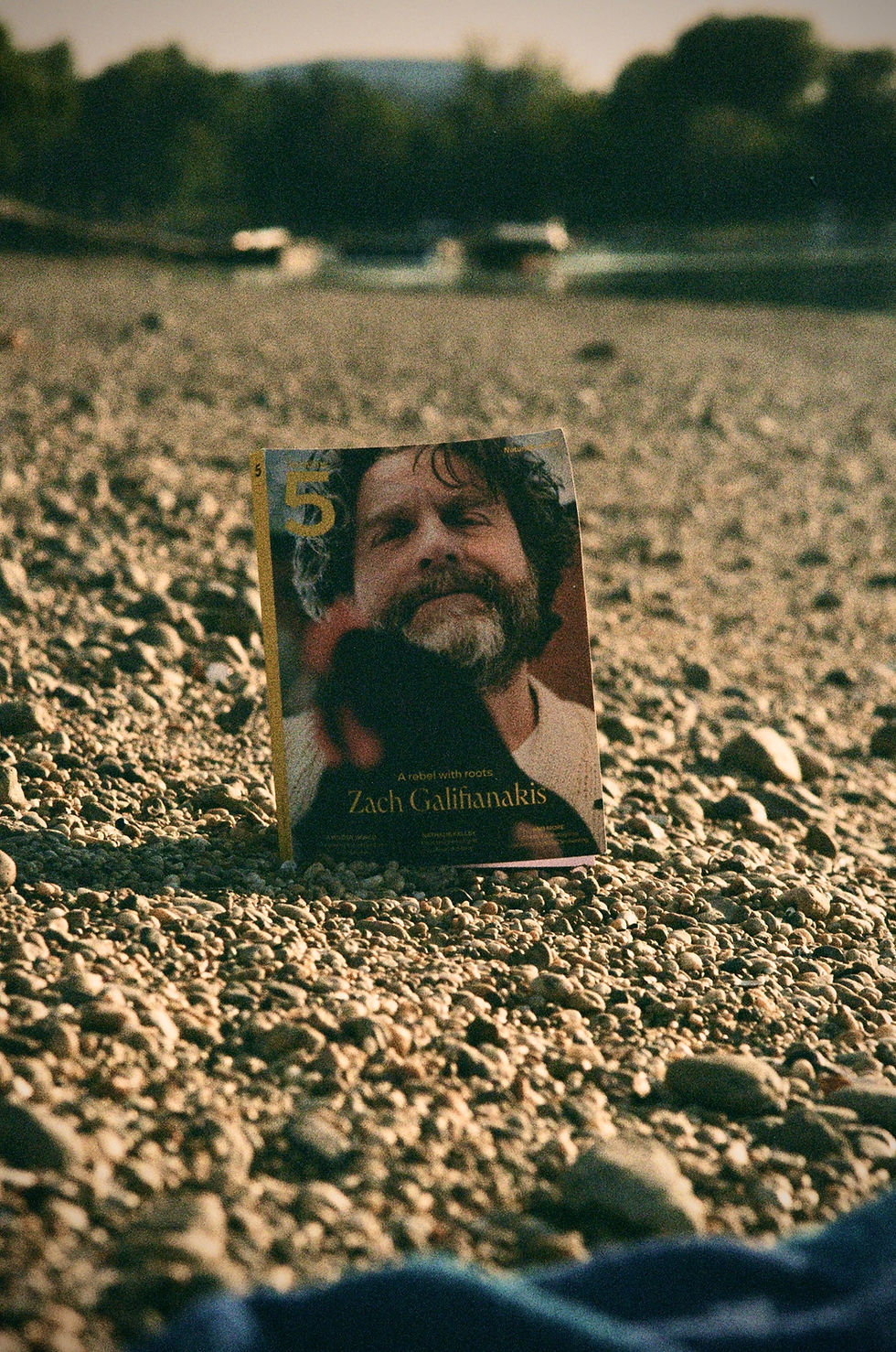
There is, for instance, a long conversation with Zach Galifianakis, this issue's cover star — the comedian who spent years interviewing people between two potted ferns before, in a wonderfully improbable turn, becoming a gardener himself. I had already watched his Netflix gardening series, yet the story still made me laugh out loud. His particular combination of self-deprecation and genuine curiosity feels almost disarming. Beneath the jokes is a quiet conviction that tending a garden might be one of the more honest things a person can do.
Then there are butterfly wings photographed under a microscope: impossible structures, patterns appearing with such extraordinary precision that I found myself wondering where nature ends, and human creativity begins. Fibonacci spirals. Golden ratios. Beauty that existed long before anyone thought to name it.
Another stories travel to Denmark and then to Transylvania, following rewilding projects and the return of species that had disappeared from those landscapes. But again, the story doesn't stop at biodiversity or ecology. It asks what happens to local imagination, local economies, local tourism when a landscape begins to become something else.
And then there is preserving.
Our grandmothers' preserving, pickling, fermenting - all those jars I remember from childhood, opened in the middle of winter, somehow making summer appear on the kitchen table. Things that once felt ordinary, even old-fashioned, quietly returning as part of a more sustainable way of eating.
Imagine5 has a knack for finding these connections without forcing them. Nothing feels like a lesson. Everything feels like an invitation.
And then there is the physical object itself. The paper. The photography. The typography. The color. The restraint. It is beautiful in a way that never feels decorative for its own sake. The design doesn't sit on top of the stories; it becomes part of the argument. You want to linger on a page, not because you have to, but because somebody has made lingering worthwhile.
I read all 188 pages almost in one sitting.
By then, the magazine had travelled around the island with me. It was left open on tables. Carried from one room to another. Read, closed, returned to. Its pages had begun to curl slightly at the edges - that particular softness a magazine acquires only when it has been properly lived with.
There was something deeply satisfying about that. A magazine about paying attention, read slowly in a place that makes paying attention almost unavoidable. For most of those nine days, the island seemed to exist outside the urgency of everything else.
Almost. On the final two days, Formula 1 arrived in Budapest.

Suddenly, helicopters began crossing the sky above us. At the height of it, there seemed to be one every few minutes, carrying drivers, team members, sponsors and thousands of "VIPs" from a small airport near the island towards the track a few kilometers away.
I have a soft spot for that travelling circus. I loved Formula 1 as a child, completely and without irony, so I don't have the luxury of pretending I occupy some perfectly consistent position here. Still, the contrast was difficult to ignore. There I was, sitting on a quiet island in the Danube, reading a magazine that is so attentive to the environmental consequences of its own existence that it publishes the carbon footprint of its printed pages - roughly the equivalent, by their calculation, of running a bath. And above us, helicopters were burning fuel by the tonne. Nobody seemed to be counting. (If so, find the F1 Net Zero claim here) All for saving a couple of minutes in the traffic...
Perhaps that contradiction belongs in the story too. Because sustainability, at least as Imagine5 approaches it, is not about constructing a world without contradiction. It is about becoming more attentive to the contradictions that are already there - and finding better, more imaginative ways of living with them.

By the time I finished the last page, the island had become strangely familiar. So had the magazine.
I closed it and realized that what I had been waiting for all those weeks wasn't simply a new issue. It was this particular experience of reading it.
Slowly. Somewhere. With nowhere else I needed to be. A kilometer from everywhere.
I'm already waiting for the sixth one.


